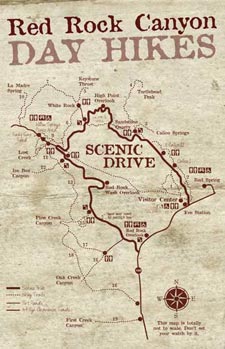
The Red Rock Canyon National Conservation Area is located just a few miles west of Las Vegas and encompasses 195,819 acres within the Mojave Desert. Red Rock Canyon is an area of world wide geologic interest.
Many experienced and amateur geologists alike who visit Red Rock are amazed by the rock formations, natural beauty, and the vivid colors of the rocks. The forces of nature that have formed such a visual display have taken years to create the masterpiece that is now known as Red Rock Canyon National Conservation Area. We invite you to explore and view the geological features that make this area unique.
Keystone Thrust
The Keystone Thrust Fault is like the famous San Andreas Fault (a break between two major rock bodies along which the break is vertical) the Keystone is horizontal. It began as gray limestone layers were pushed east during the end of the age of dinosaurs and ultimately “ramped” up through Jurassic Aztec Sandstone. Estimates of total eastward movement along this fault are as high as 40 miles. This fault shows the Cambrian Bonanza King formation (gray) folded over Aztec sandstone (red).
Eroded Rocks
Erosion is nature’s master sculpture. Wind, rain, ice, growing crystals, gravity, and weak natural acids all take their turn, wearing away seemingly immutable rock. Like artists, each force has its own distinctive signature, creating the diversity of scenic wonder we see today.
Petrified Wood
Fossils such as petrified (or permineralized) wood are some of the key clues used to reconstruct past environments. Most of the fossil logs found in Red Rock Canyon belong to an extinct genus.
Cross Bedding
As wind-blown sand piles up into dunes, the windward sides of the dunes have a gentler slope than the steep leeward sides. The resulting pattern of curving, angled lines called cross beds, leaves a record of the direction of the prevailing winds at the time.
Spring Mountains
The Red Rock Canyon National Conservation Area is located on the east side of the Spring Mountains, the highest mountain range in southern Nevada. This landscape of biological and geological diversity as we currently know it is only a snapshot taken from a continuum of constant change that spans millenia.
Conglomerate
Conglomerate is rock made up of smaller rocks and pebbles cememted together. Shinarump Conglomerate, which is widespread throughout the Western U.S., contains quartz, sandstone, basalt and fragments of petrified wood.
Aztec Sandstone
As the wind shifted the sands back and forth, angled lines developed in the sand known as “cross beds”.
Flash Floods
This wash was cut in thirty minutes in 2004 by a flash flood.